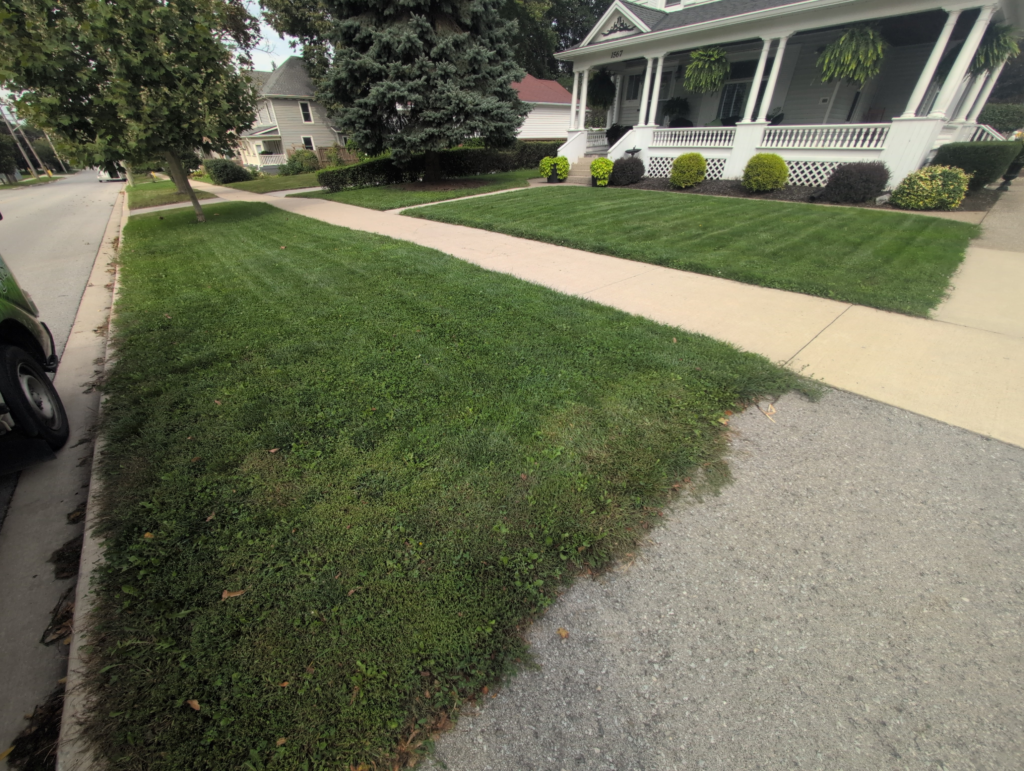
A note to people doing soil-first lawn care
You are allowed to be angry.
You spent years putting NPK and sprays on the ground. You saw what it did to soil, water, insects, and your own health. You changed. That costs something. Then a client who cuts short, won’t water, and still wants a magazine lawn decides after a few visits that they know better — and that you failed.
That is not a small thing. It is insult on top of unpaid education.
Two jobs got mixed together.
Your job: rebuild soil. You said the timeline. You said the weeds would surge. You said cut high. You showed up.
Their job: live with a different picture while the soil changes. A lot of people never take that job. They want a one-hit wonder and none of the habits that make any lawn work — chemical or not.
They will not “do it better” on their own. They will cut it how they like, buy a bag, spray the front, and call the green weeks a success. When it slides, they will not call to say you were right.
Rain is forgiving to their program. It is honest with ours.
This year made that plain.
Heat cooked the grass. Then the rain came hard. Conventional fertilizer loves that sequence. Water it in. Salt nitrogen moves. The lawn greens. The spray truck knocks down what the rain flushed up. The picture looks managed. Rain forgives a salt program. It hides the cost in the drain, the groundwater, and next month’s application.
Soil-first work does not get that forgiveness. The same rain sits in the low corner. Creeping Charlie and wild strawberry take the pond. Dandelions jump. Lawns that looked clean go weedy. The client reads that as “your program stopped working.”
What stopped working was the weather the chemical industry never had to answer for, because they spray the picture back on. We don’t.
Clean can go weedy in a brutal season without the soil work being a lie. Legacy plus weather writes the timeline. Rain does not rescue a living system with a bag. It shows you where structure and infiltration still aren’t there. That is the truth. It is also why people cancel.
Anger here is not cruelty. It is grief for the years you burned doing it the old way, plus the insult of being treated like a vending machine. Use it. Don’t mail it to the customer. Don’t turn it on your crew. Put it into standards.
The chemical industry sold a magic wand for fifty plus years. You used to sell it too. You stopped. They haven’t. That gap is the work. It will keep producing this feeling. It does not mean go back. It means you stop taking people who cannot live in the gap.
Guideline: set the relationship before the first tank
- Say the picture out loud. If they want zero weeds by month three, you are not the company.
- Put the timeline in writing — and tie it to legacy and weather.
Seasons, not visits. After years of bagged fertilizer and sprays, 36–48 months is the honest clock. Weather moves that clock. Excessive heat, then heavy rain, will push weeds even on lawns that looked clean. That is not a new failure. Write it down before the first application: legacy load + this year’s weather = the picture you will see, not a date you can guarantee. - Name the messy middle before it happens.
Weeds can surge while minerals unlock. Lawns that looked clean can go weedy after heat and rain. Charlie, dandelion, clover, strawberry occupy wet, stressed, or thinning ground. That is the initial response phase and a weather phase. It does not mean nothing happened. Say this before September, not after they cancel. - Name their half. Cutting height, water, and patience are not extras. They are the program.
- Separate service from outcome. A great technician and a weedy month can both be true.
- Explain once, clearly. After that, they own the choice.
- Do not discount your way into a bad fit. Cheap and chemical-minded is the most expensive account you will keep.
- Say what rain does. On a salt program, rain is a feature. On a soil program, rain is a test. Don’t let them compare your wet September to their neighbour’s sprayed-and-fed green without saying that out loud.
The standards
We will
- Build soil with biology, carbon, minerals, and process — not salt NPK and killer sprays
- Tell the truth about weeds, water, weather, and time before money changes hands
- Measure what we can: structure, infiltration, biology, density — not only colour
- Walk away from jobs that require a lie
- Support the lawn through the ugly middle without pretending it is already finished
- Treat a clean lawn that went weedy after heat and rain as information, not as a reason to reach for their bag
We will not
- Promise a poison-program picture on a soil-program clock
- Compete with Scotts on two-week green-up
- Treat short mowing, no water, and a flood year as our failure
- Spray weeds to keep an account that rejected the process
- Apologize for a transition we already described
- Carry the whole job while they change nothing
- Let rain be used as proof that fertilizer works and biology doesn’t
The client’s standards, said up front
- Cut at 3 inches or higher. Skip a cut in heat.
- Water only when the soil needs it — deep, not daily panic.
- Expect plant diversity while the soil rebalances — especially after extreme weather.
- Give the process more than one season, and more than one kind of summer.
- Ask questions. Don’t rewrite the agreement in September.
If they cannot sign that, they are not a no. They are a not-yet — or a never. Both are cleaner than a mid-season cancellation that blames you for physics.
The cancellations are loud. They are not the whole book. Keep the ones who stay. Keep the standard. Angry and precise still builds soil. Angry and bitter starts spraying people.
Rain will keep forgiving the bag. It will keep telling the truth about the soil.
Pick which story you are willing to stand in.
Nature doesn’t work in applications. It works in processes.
Our job is not to force a result. It is to restore the system that creates it — and to stop selling that job to people who want a wand.
Rooted in real health.
For the ones doing the work.