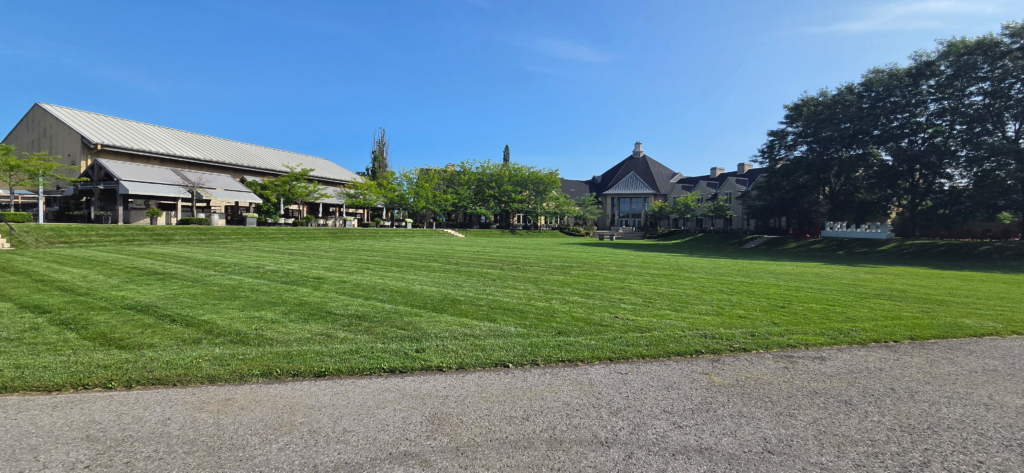
Most lawns are fed like they’re hungry.
They’re not. They’re unemployed.
The soil food web that used to chew thatch, open clay, and feed the grass got compacted, short-cut, sprayed, and starved. Then dandelions show up and we blame the dandelion.
Nature’s Brew puts a working crew back in the ground. It does not erase weeds.
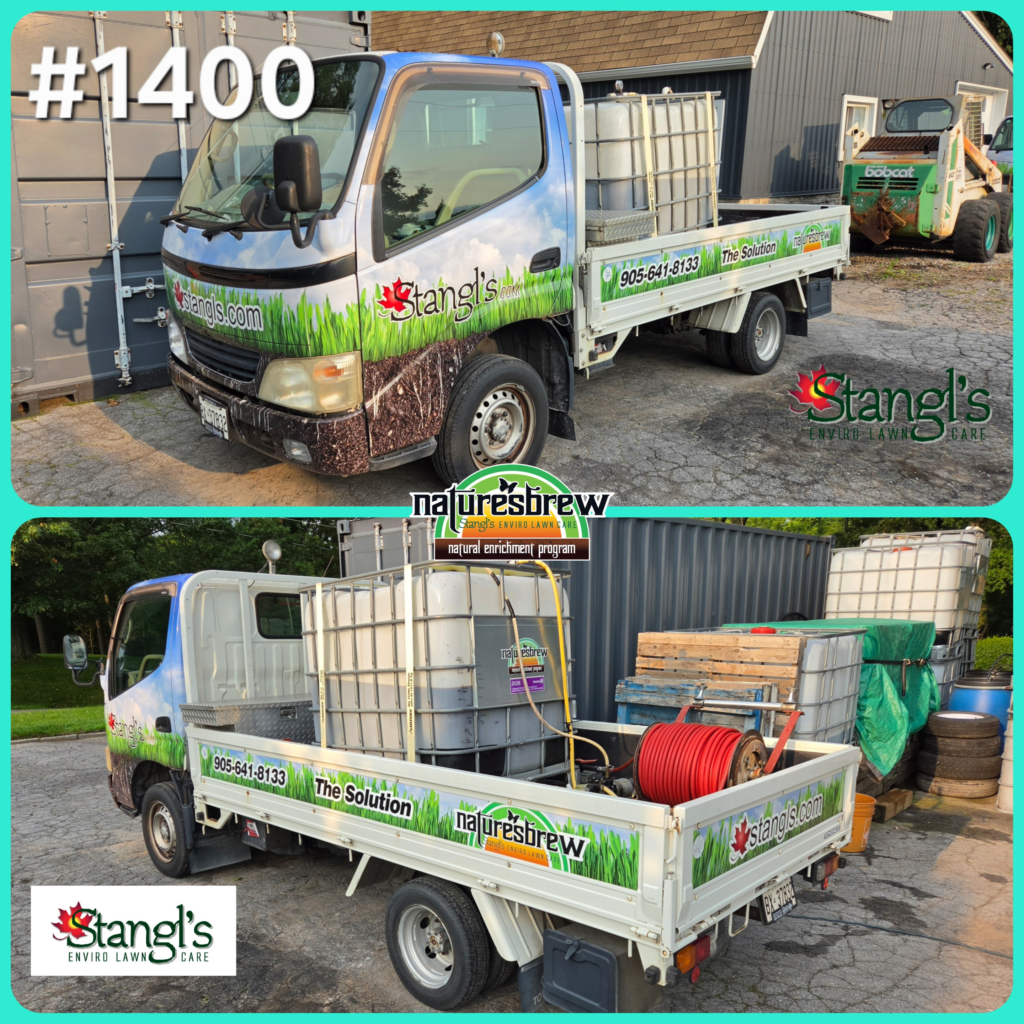
It is not “compost tea” in the hobby sense
We started brewing teas in 2015. By that first May we had already moved to extracts. We still test. We still write it down. Dr. Elaine Ingham’s work got us started. David Johnson’s Johnson-Su work gave us the long, quiet, aerobic cure. The field gave us the rest: clay that goes from blue to red to sand, hot dry summers, compacted lawns, vineyards, market gardens, orchards and greenhouses.
Nature’s Brew is the liquid we pull from that long-cured, worm-worked pile. It is an inoculant with food, not a green bag of salt.
What the tests actually say
Two different kinds of tests, two different truths, both useful.
DNA testing done on our mature compost found 4,142 microbial species — bacteria, fungi, and the rest of the community. That is a large named community. It does not mean every species is doing heavy lifting every day. It means the library is big.
Living biomass (microBIOMETER) — run here and independently with Matt Powers on the same sample bioreactor — came back 5.8:1 fungal-to-bacterial biomass. That is the number that matches what Dr. Johnson was pointing at: not a list of names, but how much living fungal mass is in the material.
DNA tells you who can be there.
Biomass tells you who is carrying the weight.
Spore counts tell you how much inoculum you can actually move per pound.
We use all three. That is why we are comfortable treating this as a low-rate biology product, in the same family as Johnson’s 2 lb per acre inoculant idea — not as a dump-truck fertilizer.
What that biology is for
On paper, a diverse aerobic compost community is there to do unglamorous work:
- Break down residue and thatch instead of leaving it as a mat
- Cycle nutrients that are already in the soil instead of only adding more
- Help soil crumbs form so water and air can move
- Support roots under heat, drought, and compaction
- Compete with the organisms that show up when soil is tired
Our DNA work showed strong marks on phosphorus mobilization, iron acquisition, and plant stress adaptation. That matches what we see on lawns and in the Marsh: plants that hold longer when the clay bakes, and soil that is slower to seal over.
Why we keep it in a bioreactor
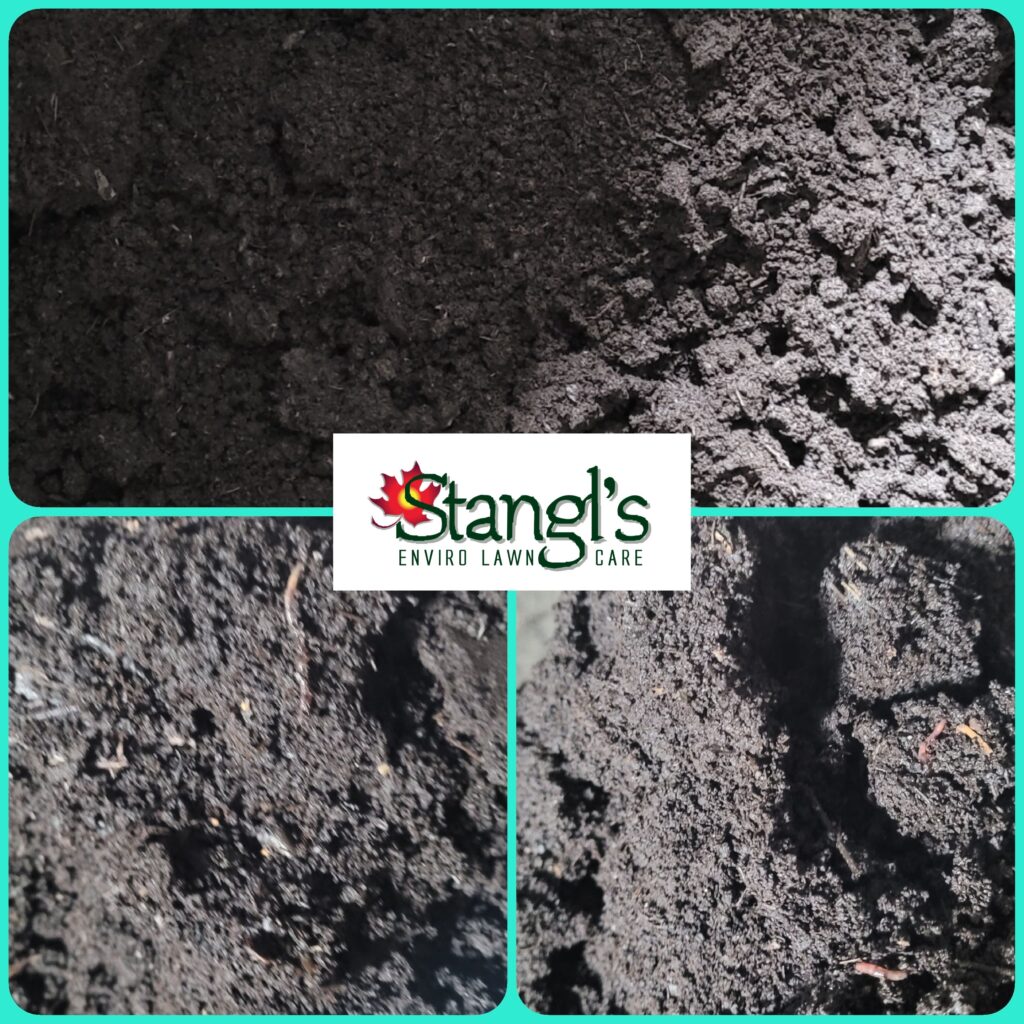
The pile is not flipped like a municipal windrow. We layer — pumpkin, then compost, then food again — so worms keep a reason to move up and down. Air access stays open. Compaction stays down so the middle does not go sour.
Johnson’s slides showed something simple: young compost is owned by a few groups. A year of still, moist, aerobic time spreads the work across many more. We have taken that idea and kept feeding it for four-plus years. The result is not a dead, finished powder. It is a living stock we extract from.
How little you actually need
Johnson’s field work treated finished bioreactor compost as an inoculant at about 2 lb of solids per acre, usually extracted into water and applied as a foliar or in furrow.
That is the base we use for thinking, not a religion.
- One-shot field or vineyard inoculant: about 2 lb compost-solids per acre in the extract
- Compacted Niagara lawns: 2–4 lb solids per acre per pass is the practical range
- Season-long lawn program: several passes, same payload idea each time — small pounds, repeated, not one magic dump
The gallons in the tank are just the delivery truck. The number that matters is how much of that living compost actually left the bioreactor and hit the acre.
What people can expect
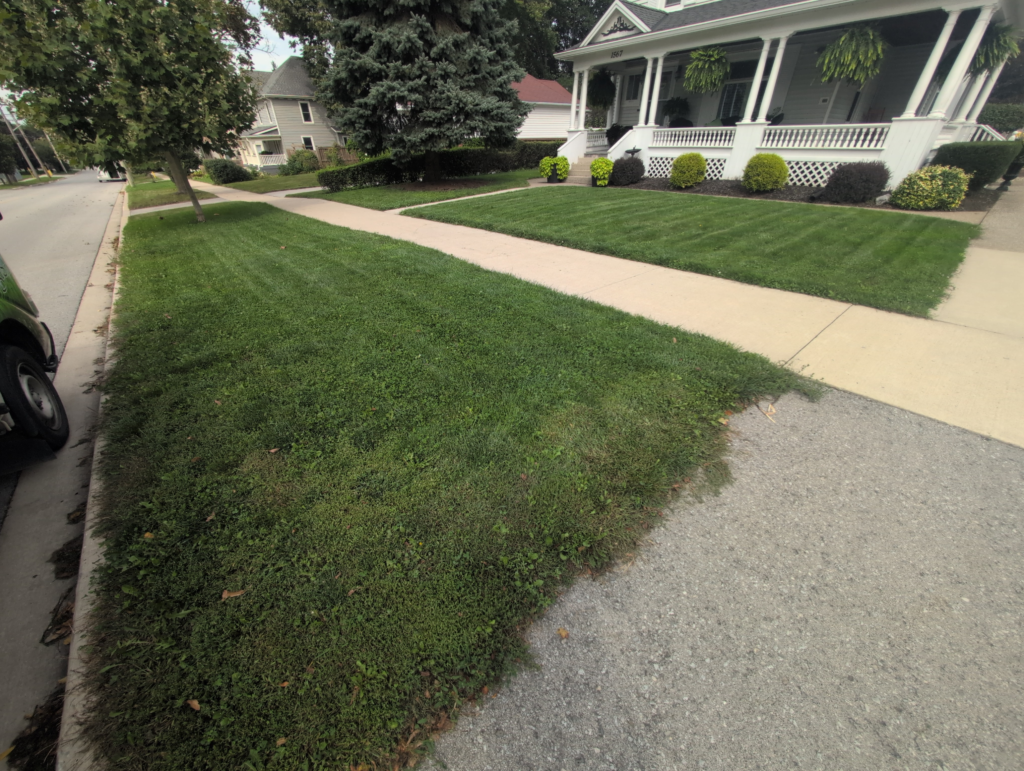
We cannot promise a weed-free lawn. We don’t try.
Dandelions especially are a soil-and-mowing story: leftover compaction, legacy fertility, short cutting, thin turf, and dry clay that opens a hole. Some properties push through and the weeds fade as the grass fills. Some stay the same. A few look worse at first because the soil is finally moving and the weak spots show.
If you are switching from conventional spray programs because you want the dandelions gone by July, this is the wrong product. You will be disappointed. Compaction, short mowing, and years of salt-and-kill don’t vanish in one season of biology.
What we will work toward: soil that takes water, grass that competes better, fewer “rescue” sprays if any and a lawn that gets more honest over time — not a magazine picture with no yellow flowers.
First weeks: soil often smells more alive, water soaks instead of sheeting, grass may colou
Honest timeline, not a commercial:
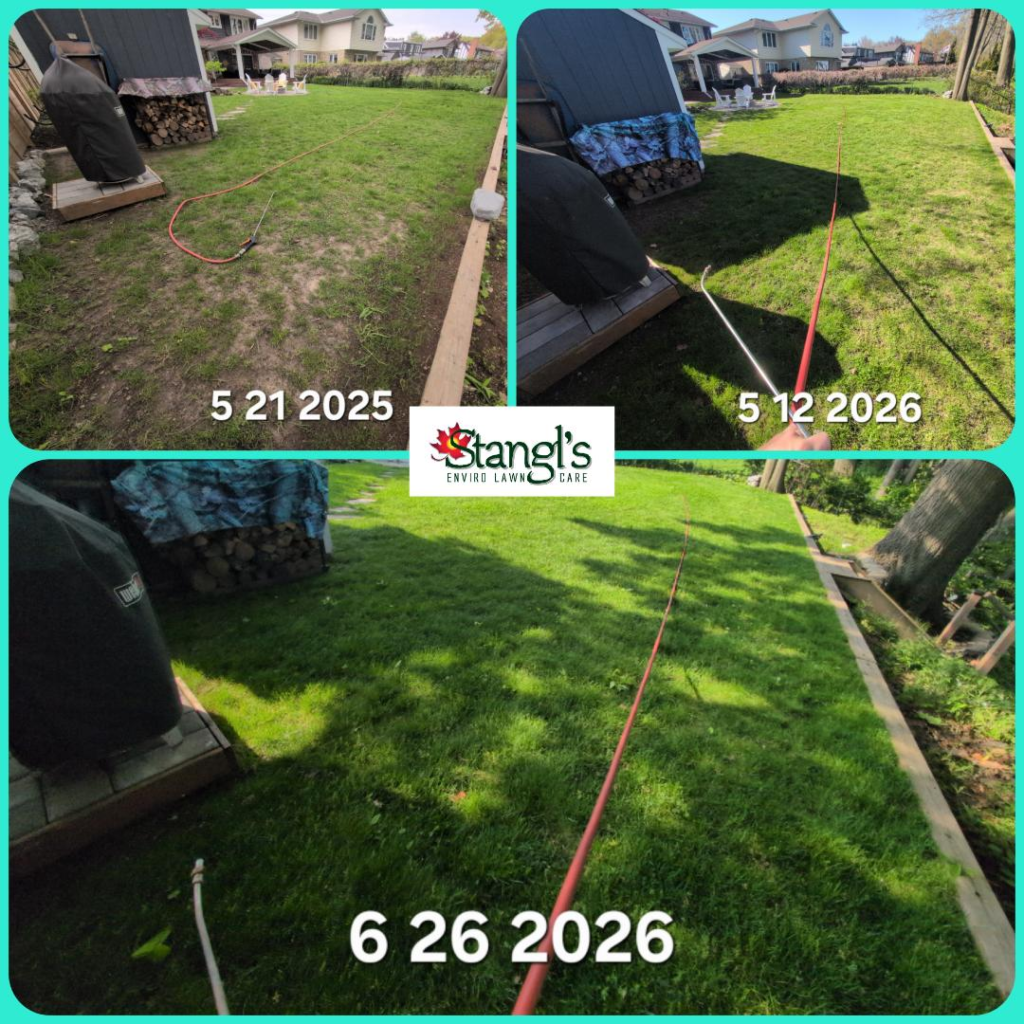
First few weeks to year: soil smells more alive, water soaks instead of sheeting, grass often colours without a salt spike.
Second season into third: better recovery after heat, less thatch feel, fewer “rescue” problems if you also aerate and stop starving the soil.
Year four and after: structure is the real prize. Weeds that live on compaction and leftover potassium get less of a free ride. They do not always disappear. The lawn gets better at filling the space they used.
If someone promises “no weeds, no insects, no drought, 30 days,” that is not this product. This is slower, and it stays after the truck leaves.
Who it is for
- Home lawns on heavy clay that have been compacted and chemically managed
- Vineyards and orchards that want biology in the row, not just another salt
- Market gardens and greenhouses that need a clean inoculant they can stack with other passes
- Anyone tired of feeding the plant and ignoring the soil that has to carry it
If that sounds like the job you actually want done, call us. If you need zero weeds no matter the soil, stay with what you have.
Nature’s Brew is one tool. We often pair it with carbon (pelletized compost), minerals when a test says so, and, where it fits, other biological and amino-acid materials. The brew is the living core.
Ready when the lawn is tired of being treated like a plant, not a soil
This is for Niagara homeowners, clubs, vineyards, market gardens, and greenhouse growers who are done buying colour in a bag and still fighting compaction, drought, and the same weeds every June.
Stangl’s Enviro Lawn Care builds and brews Nature’s Brew here in St. Catharines since 2018— eight-plus years in the bioreactor, worms still working, DNA and biomass tested, sprayed on real clay, sand, and everything in between. We don’t sell a miracle in 30 days. We put a living crew back in the ground and keep showing up.