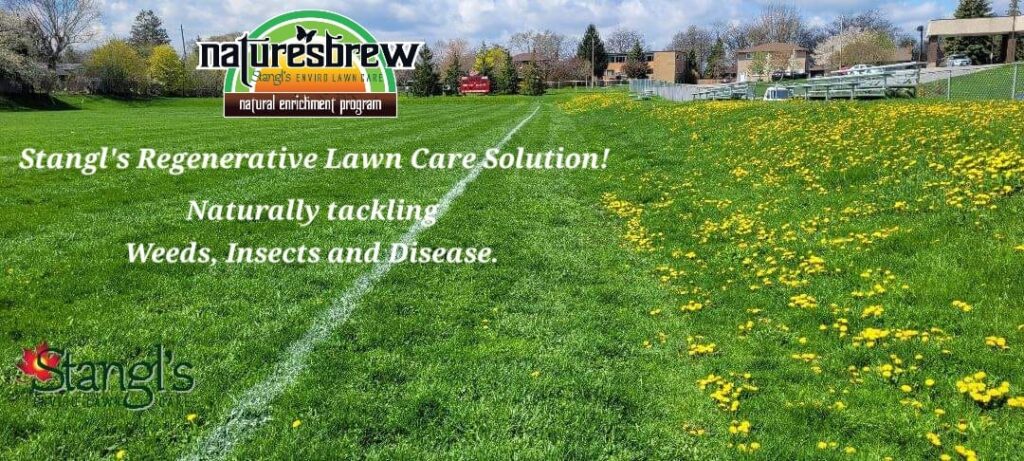
Hey there, fellow lawn enthusiast! At Stangl’s Enviro Lawn Care, we see weeds not as enemies to battle with chemicals, but as helpful signals from your soil. In regenerative lawn care, weeds like: dandelion, creeping Charlie, clover, crabgrass, purslane, knotweed, mallow, quackgrass, black medic, Canadian thistle, field bindweed, chickweed, and moss show up in disturbed, compacted “dirt” to do specific jobs: break up hard soil, balance minerals, add organic matter (OM), and restore balance. They’re pioneers in nature’s succession process—responding to imbalances like low calcium (Ca), compaction, or bacterial dominance.
As your soil gets healthier through regenerative practices (e.g., adding biology and carbon), it naturally flocculates—aggregates form, improving structure and releasing “locked-up” minerals between clay particles (e.g., potassium (K) first, then calcium (Ca), phosphorus (P), magnesium (Mg), zinc (Zn), and manganese (Mn)). This reduces weed pressure because their “jobs” are done. To advance your lawn: Apply carbon-rich inputs (compost, mulch, or our Nature’s Brew) to build OM (>6%), foster fungi, and suppress germination—weeds thrive in low-carbon, disturbed soils, so carbon stabilizes the system, preventing those “healing crises” where weeds surge during transitions.
Here’s a breakdown of those weeds, based on regenerative experts like Nicole Masters (from her “Read the Weed” guide and talks). We focus on what they indicate, their jobs/benefits, biomass ratios (fungal:bacterial preference—bacterial for early weeds, fungal for later succession), and tips to “outgrow” them regeneratively. No sprays needed—fix the soil, and they fade.
Common Lawn Weeds: Indicators, Jobs, and Regen Management
| Weed | Key Indicators (Soil Issues) | Job/Benefits (What It Does) | Biomass Ratio (Microbial Preference) | Minerals Involved/Released | Regen Tip to Advance Health |
|---|---|---|---|---|---|
| Dandelion | Compacted, acidic, low Ca, low OM, bacterial dominance | Deep taproot breaks compaction; adds biomass/OM; accumulates P, K, Ca | Bacterial (early succession) | Releases K/Ca upon decomposition; indicates low Ca | Aerate biologically (e.g., earthworms via compost); add Ca-rich amendments like gypsum. Flocculation unlocks K, reducing need. |
| Creeping Charlie (Ground Ivy) | Compacted, shady, moist, low fertility, bacterial | Covers bare spots, suppresses erosion; accumulates Fe, Cu | Bacterial-dominant | High in Fe; signals low Mn/Zn | Increase light/diversity; build fungi with wood chips/carbon to shift balance—suppresses germination in shaded areas. |
| Clover | Low N, compacted, low OM, poor drainage | Fixes N (adds fertility); improves structure; attracts pollinators | Balanced (mycorrhizal if healthy) | Accumulates Ca, P, B; indicates low N | Embrace as cover; if invasive, boost OM/carbon to favor grasses—flocculation releases P/K, reducing N-fixing need. |
| Crabgrass | Compacted, dry/thin turf, low Ca, high Mg, bacterial | Covers bare soil, prevents erosion; quick biomass addition | Bacterial (warm-season annual) | Accumulates K; signals high Mg/low Ca | Seed diverse perennials; add carbon mulch to cool soil/suppress seeds—healthy flocculation unlocks Ca, crowding it out. |
| Purslane | Compacted, low OM, dry, bacterial | Succulent leaves retain moisture; accumulates P, K; edible/nutritious | Bacterial | High in omega-3s, P, K; indicates low fertility | Build OM with compost teas; carbon applications reduce germination by stabilizing moisture—releases bound P. |
| Knotweed | Compacted, poor drainage, low OM, bacterial | Deep roots aerate; accumulates heavy metals/toxins | Bacterial-dominant | Signals low fungi; accumulates Zn, Cu | Promote fungal dominance with woody mulches; flocculation improves drainage, releasing Mg/K to discourage it. |
| Mallow | Compacted, low Mn, bacterial, moist | Taproot breaks soil; mucilage improves structure; medicinal | Bacterial | Accumulates Mn, Ca; indicates low Mn | Add Mn-rich amendments (e.g., greensand); carbon boosts fungi/OM, suppressing via better aggregation and mineral release. |
| Quackgrass | Compacted, low OM, bacterial, invasive rhizomes | Rhizomes aerate/break hardpan; adds deep biomass | Bacterial (cool-season perennial) | Accumulates K; signals compaction/low Ca | Over-seed with competitive grasses; heavy carbon mulching smothers rhizomes—flocculation unlocks K, reducing spread. |
| Black Medic | Low N, compacted, low Ca, bacterial | Fixes N; covers bare spots; accumulates P, K | Bacterial (legume) | Indicates low N/Ca; releases P upon decay | Balance with diverse covers; add Ca/carbon to build structure—releases bound Ca/Zn, favoring desired turf. |
| Canadian Thistle | Compacted, low Ca, high K/Mg, bacterial | Deep roots mine minerals; breaks compaction; accumulates Ca, P | Bacterial-dominant | High K/Mg indicator; releases Ca/P | Cut before seed; add carbon/compost to build fungi/OM—flocculation balances K/Mg, making soil less hospitable. |
| Field Bindweed | Compacted, low fertility, high pH, bacterial | Vines cover/protect; deep roots aerate; accumulates K | Bacterial | Signals low OM; releases K/Zn | Persistent mulch/carbon layers suppress; improve fertility via biology—unlocks P/Ca through aggregation. |
| Chickweed | Moist, low fertility, bacterial, shaded | Covers wet spots; quick OM addition; edible | Bacterial (cool-season annual) | Accumulates P, K; indicates high moisture/low N | Improve drainage with OM/carbon; add light/diversity—releases bound N/P as soil flocculates. |
| Moss | Acidic, compacted, shaded, poor drainage, low OM | Retains moisture; indicates low pH/bacterial excess | Non-vascular (fungal-like) | Signals low Ca, high acidity; no mineral accumulation | Lime for Ca/pH balance; aerate/add carbon to build structure—flocculation improves air/water flow, discouraging growth. |
Advancing to Health: Key Strategies
- Observe & Test: Dig/test for compaction (penetrometer >300 psi?); check pH (aim 6-7), OM (>5%), EC (0.2-1.0 mS/cm). Weeds signal fixes—e.g., dandelions/thistles mean add Ca/carbon.
- Build with Carbon: Apply compost/vermicast (30 lbs/acre) to boost OM/fungi, suppress germination (weeds need disturbance/low carbon); pairs with our Nature’s Brew for microbial kickstart.
- Diversity & Cover: Overseed multispecies (clover ok as ally); living roots year-round release exudates, promoting flocculation/mineral unlocks without surges.
- Monitor Progress: As soil flocculates (aggregates form), K releases first (may spike weeds temporarily)—buffer with carbon. Track with our microscopy/epifluorescence services.
- Outcomes: Healthier soil self-regulates—fewer weeds, resilient turf (deeper roots hold 30%+ more water), zero chemicals needed.
Ready to “school up” on your weeds and unlock soil health? Dive into our blogs at stangls.com/blog or hit us up at @StanglsEnviro on X. Let’s make your yard thrive regeneratively—contact us for a free consultation!
Rooted in Regen
Unlocking Soil Wealth
Michael Stangl