The 185-Year Lie: Why Conventional Lawn Care Is Still Selling You 1840 Science in 2026
In 1840, Justus von Liebig published his NPK theory: plants need only nitrogen, phosphorus, and potassium. It was a breakthrough. It was also incomplete. Liebig himself later admitted he had overlooked organic matter, humus, and the living biology of soil. That single admission has been ignored for 185 years.
The conventional lawn care industry never got the memo.
They still sell you the same 1840 foundation—salt-based fertilizers and synthetic killers—as the silver bullet, the magic wand, the simple solution. More NPK, more sprays, more green, more profit. They call it “professional.” They call it “safe.” They call it “the way it’s always been done.”
And every fertilizer factory can be converted into an ammunition factory overnight. That’s not conspiracy; it’s history. The same chemistry that grows lawns fast fueled wars. Nitrogen bombs and nitrogen fertilizers are two sides of the same coin. Yet the industry keeps selling it, because greed and convenience win when people don’t question.
Meanwhile, the real science has been building since Liebig’s correction.
Sir Albert Howard proved in the early 1900s that composting and returning organic matter to the soil creates healthy plants without chemicals. William Albrecht mapped how soil minerals directly affect animal and human health. Elaine Ingham spent decades showing the soil food web—microbes are the engine of fertility, not NPK. Graham Sait advanced nutrition farming, proving balanced biology builds plant immunity. Christine Jones revealed liquid carbon pathways and mycorrhizal networks that regenerate soil faster than anyone thought possible. David Johnson’s fungal bioreactors demonstrated massive carbon sequestration. James White discovered the rhizophagy cycle—plants actively “eat” microbes to extract nutrients. Kris Nichols quantified glomalin’s role in soil aggregation and carbon storage. David Montgomery chronicled how soil degradation toppled civilizations—and how regenerative practices can reverse it. John Kempf brought it all together with “living systems” thinking. Gabe Brown and Joel Salatin showed it works at scale on real farms. Nicole Masters, Ewan Campbell, Joel Williams, and countless others continue proving it in the field.
This is 2026 science—boots-on-the-ground, microscope-verified, measurable reality.
We know:
- Weeds, insects, disease, drought stress, compaction—these are symptoms of dead dirt, not random problems to spray away.
- Salt fertilizers burn organic matter, collapse structure, reduce water-holding capacity, and create dependency.
- Pesticides kill beneficial biology, leaving soil sterile and plants weak.
- The “visual field” is a lie. Green and fast-growing does not mean healthy. It means addicted.
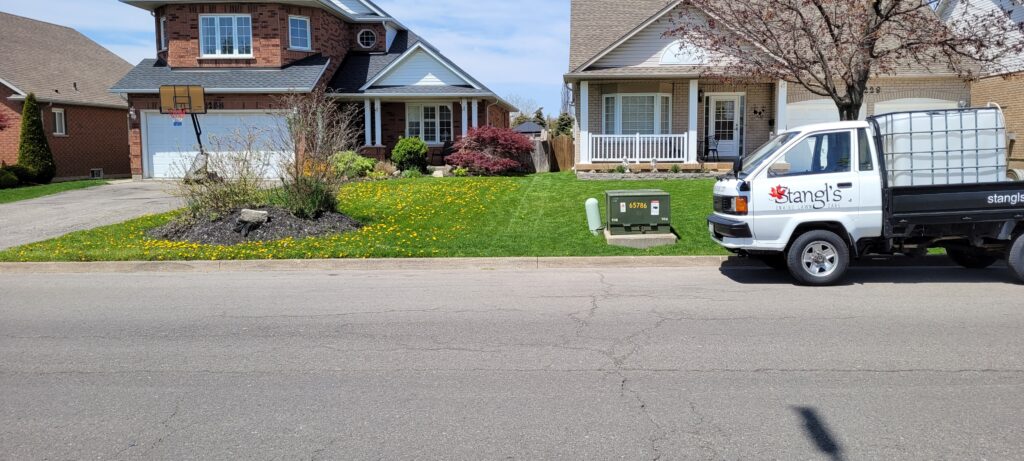
At Stangl’s Enviro Lawn Care, we rejected that insanity years ago. Been in it now for 45 years. We measure fungal-to-bacterial ratios, compaction (PSI), Brix, EC, real-time nutrient absorption with our epifluorescence microscope. We build living soil with Nature’s Brew, PUC Pelletized Ultimate Compost, and biology-first practices. Insects and disease are almost non-existent. Weeds fade as outcomes of healthy soil, not enemies to poison. Our lawns are resilient, deep-rooted, and alive—not dependent on the next chemical fix.
The industry wants you to believe their silver bullet still works. It doesn’t.
The pioneers have been telling us the truth for over a century.
We listen. We measure. We build.
Your lawn is part of a living system that includes you, your family, your pets, your community, and the planet. Choose regenerative. Break the 185-year cycle.
#AwakenSoil #Stangls #Niagara #RegenerativeLawn #EcoSafe